Finding China’s best Vintage Retro Bluetooth Speaker supplier requires more than attractive product photos. A reliable partner should combine classic styling with stable engineering, clear communication, and consistent quality control. Buyers should examine cabinet materials, speaker drivers, battery capacity, Bluetooth performance, and production experience. A walnut-effect finish may look convincing online, yet color consistency can change between samples and bulk orders.
A professional supplier should provide working samples, technical specifications, factory information, and realistic production timelines. Ask for details about charging safety, wireless compatibility, packaging strength, and quality inspections. If the product will enter different markets, confirm applicable safety, radio, battery, labeling, and environmental requirements with qualified testing agencies. Compliance should never depend on assumptions or copied certificates. That approach can create expensive problems later.
Practical evaluation matters.
Request a sample before negotiating large volumes. Test pairing speed, connection stability, knob response, sound clarity, and battery performance in ordinary rooms. Check whether the retro grille feels secure and whether the wooden surface resists small scratches. Factory visits, video inspections, and independent testing can strengthen supplier verification. However, no supplier is perfect. A prototype may reveal weak bass, uneven paint, or loose controls. These flaws are useful warnings, not reasons for immediate rejection. They show where communication and product revision are needed.
The strongest partnership develops through documented specifications, honest feedback, and repeat inspections. By comparing manufacturing capability, design flexibility, certification support, and after-sales responsiveness, importers can identify a dependable Chinese supplier. The goal is not only a beautiful speaker. It is a reliable product that performs consistently from the first shipment onward.
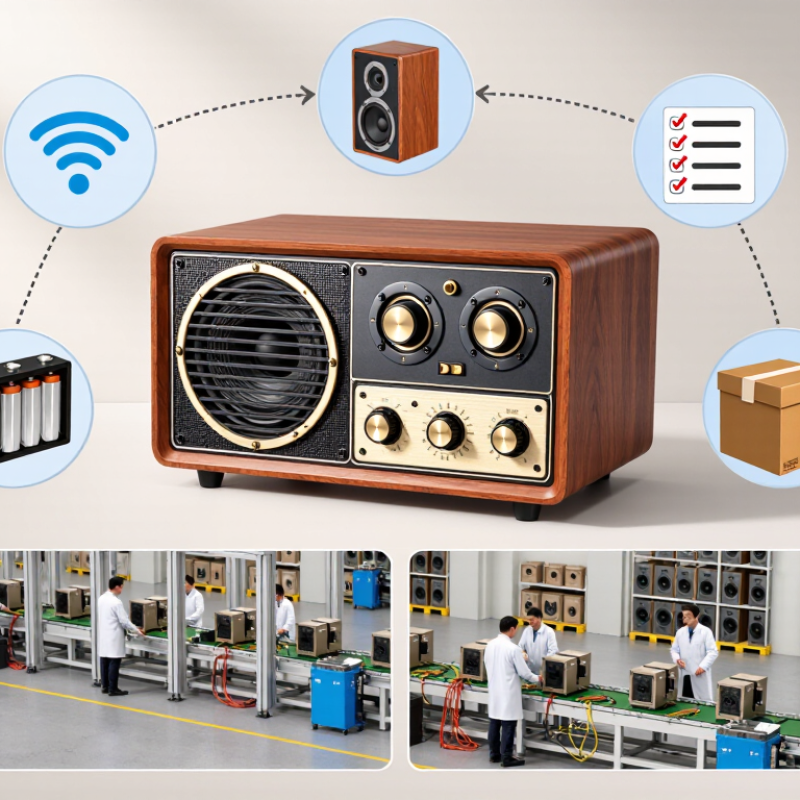
China Best Vintage Retro Bluetooth Speaker Supplier?
Vintage retro Bluetooth speakers combine old-fashioned visual cues with modern wireless audio. Typical details include wood-grain cabinets, fabric grilles, brass-style knobs, analog-inspired dials, and compact rechargeable batteries. The appearance is historical; the internal technology is not. Bluetooth connectivity, digital amplification, USB-C charging, and hands-free calling are now common specifications.
Market data supports this hybrid design. Grand View Research estimated the global wireless speaker market at about USD 8 billion in 2022, with strong growth projected through 2030. Fortune Business Insights also reports rapid expansion in the Bluetooth speaker sector, driven by portable entertainment and smart-device compatibility. These figures use different market definitions, so direct comparison can be misleading. That is worth remembering.
For buyers evaluating a China-based supplier, measurable details matter more than a polished retro shell. Ask for Bluetooth qualification information, battery safety test records, frequency-response data, distortion measurements, and sample consistency. A practical sample test should include pairing distance, charging time, knob durability, grille stability, and playback performance at low volume. Many suppliers describe warm sound as a feature, but that phrase is subjective. An experienced evaluator should also check vocal clarity and bass distortion in a furnished room, not only in a factory showroom. Small weaknesses appear there. Supplier reliability should include production capacity, inspection procedures, packaging protection, and transparent handling of design revisions.
This technical comparison shows the maximum gross wireless data rates defined for common Bluetooth transport modes used in audio products. Bluetooth Classic Enhanced Data Rate can reach 3 Mbps, while Bluetooth Low Energy supports 1 Mbps or 2 Mbps PHY modes. Actual speaker range, stability, battery life, and audio quality depend on implementation, codec, antenna design, and surrounding radio interference.
Data reference: Bluetooth Core Specification terminology and published PHY-rate limits. Values represent maximum gross air-interface rates, not usable audio throughput.
A reliable vintage retro Bluetooth speaker supplier must prove more than attractive wood panels and warm sound. Bluetooth SIG’s 2024 Market Update reports 5.4 billion Bluetooth devices shipped in 2023, with annual shipments projected to reach 7.6 billion by 2028. This growth raises the evaluation standard. Ask suppliers for Bluetooth 5.3 qualification records, radio test results, and firmware revision control. Bluetooth 5.3 can improve connection management and power efficiency, but it does not automatically guarantee stronger range or better audio.
LE Audio deserves close attention. Its LC3 codec is designed to deliver efficient audio at lower bitrates, while supporting multi-stream and broadcast audio functions. A supplier should explain whether the speaker supports standard Bluetooth Classic audio, LE Audio, or both. The answer matters. A beautiful retro cabinet is useless if modern phones connect inconsistently. Check pairing time, reconnection behavior, latency, and performance through walls. Test it in a real room, not only in a quiet laboratory.
Codec claims also need evidence. SBC support is expected for basic compatibility, while AAC or other optional codecs may improve playback with selected devices. Request measured bitrate, sample-rate limits, distortion data, and battery performance at normal volume. The Bluetooth SIG report forecasts audio-streaming device shipments rising from about 1.4 billion in 2023 to 2.3 billion in 2028. Still, forecasts can shift. I would treat every projection carefully and require independent testing, stable samples, and clear production tolerances before approving a supplier.
A retro cabinet can look heavy, but its battery may be surprisingly small. Watt-hours reveal the stored energy more clearly than capacity alone. Calculate it with nominal voltage multiplied by amp-hours. For example, a 7.4-volt, 4Ah pack stores about 29.6Wh. This figure helps buyers compare different battery designs fairly.
Playtime is less predictable. A supplier may quote twelve hours at moderate volume, yet louder playback drains energy faster. Bass-heavy music, wireless signal strength, temperature, and battery age also affect results. Ask for test conditions, including volume level and playback format. Quiet testing can create an attractive claim. Real rooms are less forgiving.
IEC 62133-2 compliance deserves careful document review. The standard addresses safety for rechargeable lithium cells and batteries used in portable applications. Request the test report, certificate details, cell configuration, protection design, and production traceability. Check whether the report matches the exact battery pack, not an older sample. That small mismatch matters. A practical supplier should explain charging protection, over-current control, and thermal safeguards in plain language. I would also request recent production samples and repeat a measured playtime test. My own expectation would stay conservative, because printed specifications can age faster than the battery itself.
A reliable Chinese vintage retro Bluetooth speaker supplier should be verified through records, not showroom appearance. The 2024 Bluetooth Market Update forecasts 5.4 billion Bluetooth device shipments annually by 2028, increasing pressure on component planning and factory capacity. Ask for monthly output, active assembly lines, and recent production schedules. A supplier claiming 100,000 units monthly should show anonymized invoices, line photos, and test records. MOQ also needs context. A low MOQ may hide higher unit prices, limited color choices, or outsourced production.
Defect rates require evidence. Request three months of inspection data, including pairing failures, battery faults, cosmetic scratches, and carton damage. Use ISO 2859-1 sampling procedures, but remember that an AQL result is not a quality guarantee. It only describes an inspection decision. The China National Bureau of Statistics reported a 2024 manufacturing PMI average of 49.2, reflecting uneven operating conditions. Lead times may therefore change with component availability and order volume. Confirm sample time, mass-production time, inspection time, and shipping preparation separately. Put each milestone in the purchase agreement.
I once trusted a supplier’s “98% pass rate” without checking its sample size. That was weak verification. Ask whether the figure covers final inspection or customer returns. A practical audit should include a live production call, serial-number tracing, battery safety documents, and a pre-shipment inspection. Factories can look efficient for one afternoon. Capacity must survive a full order cycle.
| Verification Dimension | Practical Benchmark for Vintage Retro Bluetooth Speakers | Typical Verified Range | Evidence to Request | Assessment |
|---|---|---|---|---|
| Standard-Model MOQ | Minimum order for an existing speaker design with standard color, packaging, and components. | 100–300 units per model and color | Signed quotation showing MOQ, color split, packaging terms, and product configuration. | Low MOQ |
| Custom-Design MOQ | Minimum order when changing the cabinet, grille, tooling, logo placement, or electronic layout. | 500–1,000 units per design | Tooling quotation, engineering-change form, prototype approval process, and ownership terms. | Higher Risk |
| Monthly Production Capacity | Realistic output for a factory producing comparable small consumer-electronics products. | 5,000–20,000 units per month | Production-line photos or video, equipment list, staffing information, and recent capacity records. | Verify by Audit |
| Peak-Season Capacity | Expected capacity during major retail demand periods when component and assembly schedules are constrained. | 70%–90% of stated normal capacity | Capacity reservation policy, component inventory plan, and confirmed production-slot schedule. | Plan Early |
| Pre-Shipment Defect Rate | Acceptable outgoing quality level for a finished consumer-electronics order. | Target: ≤1.5%; strong control: ≤1.0% | Recent third-party inspection reports, AQL inspection plan, corrective-action records, and rework data. | Quality Target |
| Audio and Bluetooth Failure Rate | Common functional checks covering pairing, charging, speaker output, buttons, and abnormal noise. | Target: ≤1.0% at final inspection | Functional-test checklist, test-station records, sample failure logs, and burn-in procedure. | Critical Check |
| Battery and Charging Safety | Verification of battery consistency, charging protection, overheating prevention, and transport documentation. | 100% charging and polarity test; documented battery compliance | Battery specification, UN38.3 test summary, MSDS, protection-board details, and charger reports. | Mandatory |
| Sample Lead Time | Time required for an existing model before approval, excluding international shipping. | 7–15 calendar days | Sample schedule, sample invoice, component availability confirmation, and approval milestones. | Normal Range |
| Custom Prototype Lead Time | Time required for a modified enclosure, printed artwork, new color, or revised user interface. | 15–30 calendar days | Engineering timeline, 3D files or drawings, prototype revision plan, and tooling schedule. | Allow Buffer |
| Mass-Production Lead Time | Time from deposit and approved pre-production sample to completed production. | 25–45 calendar days | Production schedule, material lead-time list, pre-production approval, and shipment-ready date. | Normal Range |
| Packaging Customization | Printed retail box, molded insert, manual, barcode label, and accessory configuration. | Adds approximately 7–15 days when artwork is not ready | Packaging dieline, color proof, print approval record, carton drop-test standard, and packing list. | Confirm Artwork |
| Pre-Shipment Inspection | Independent inspection performed after at least 80% of the order is completed and packed. | AQL 2.5 for major defects; AQL 4.0 for minor defects | Inspection scope, sampling plan, defect definitions, photographs, and signed inspection report. | Recommended |
| Warranty and Replacement Policy | Post-delivery handling for confirmed manufacturing defects and nonconforming units. | Commonly 12 months; replacement or credit negotiated by defect rate | Written warranty terms, claim deadline, replacement procedure, spare-parts policy, and credit terms. | Get in Writing |
| Payment Structure | Typical commercial arrangement for an initial production order. | 30% deposit and 70% before shipment | Pro forma invoice, beneficiary verification, bank-account consistency, and payment milestones. | Verify Carefully |
| Supplier Verification Priority | Recommended decision rule before placing a first order. | Approve only after sample testing, factory verification, and independent inspection | Business registration review, factory audit, live video verification, tested samples, and inspection records. | Best Practice |
Choosing a vintage retro Bluetooth speaker supplier requires more than attractive wood grain and warm sound. Bluetooth SIG’s 2024 Market Update forecasts 5.4 billion Bluetooth device shipments annually by 2028. That growth increases the need for documented compliance.
Ask the supplier for an IEC 62368-1 test report covering electrical, thermal, and mechanical safety. Request UN 38.3 evidence for the installed lithium battery, including transport testing records. CE marking should be supported by an EU Declaration of Conformity, not only a printed logo. FCC documentation should identify radio-frequency tests, antenna details, and the exact model number. RoHS evidence should include material declarations or laboratory screening for restricted substances.
Check every document carefully. A certificate folder can look complete—and still be weak. The report model, battery cell, firmware, and factory address should match the production sample. SGS’s Global Market Outlook and other compliance-industry reports continue to show that connected consumer devices face expanding testing and traceability demands. However, reports alone cannot prove stable manufacturing quality. I would request recent batch records, component-change procedures, and photographs of safety labels. This step is sometimes missed. It should not be.
A supplier’s experience becomes visible during technical questions. Can the engineering team explain creepage distances? Can it provide UN 38.3 test-summary documents promptly? Can it repeat RoHS testing after a material change? If answers remain vague, the low quotation may hide future delays, rejected shipments, or costly redesigns.
It combines historical styling with modern audio technology. Common details include wood-grain cabinets, fabric grilles, brass-style knobs, and analog-inspired dials. The appearance is old-fashioned. The internal system is usually modern.
Typical features include wireless pairing, digital amplification, rechargeable batteries, and USB-C charging. Some models also support hands-free calling. Check every feature in a working sample. Printed specifications can be incomplete.
Request qualification records, radio tests, battery reports, and frequency-response measurements. Also review distortion results and sample consistency. Inspect production capacity, packaging, and revision controls. A polished cabinet proves very little.
Test pairing time, reconnection behavior, range, latency, and performance through walls. Use a furnished room instead of only a quiet showroom. Play speech and bass-heavy music. Small weaknesses often appear there.
No. It may improve connection management and power efficiency. It does not automatically guarantee stronger range or higher audio quality. Ask for radio test results and firmware controls. Do not trust the number alone.
Newer standards may support efficient audio, multi-stream functions, and broadcast listening. Confirm whether the speaker supports standard audio, newer audio, or both. Codec claims need measured evidence. Compatibility can still vary between phones.
Use watt-hours rather than amp-hours alone. Multiply nominal voltage by amp-hours. For example, a 7.4-volt, 4Ah battery stores about 29.6Wh. That comparison is more useful.
Louder volume, strong bass, weak signals, temperature, and battery age reduce playtime. Ask for volume level, playback format, and test conditions. Repeat the test with a production sample. Quiet testing can mislead.
Request reports for rechargeable battery safety under IEC 62133-2 requirements. Check the exact battery pack, cell layout, protection circuit, and traceability. Review over-current and thermal protection details. An older report may not match current production.
Market reports indicate strong growth in wireless and portable audio products. However, reports use different definitions and may not compare directly. Forecasts can change. I would use them as context, not proof of demand.
Choosing the right Vintage Retro Bluetooth Speaker supplier in China requires more than evaluating appearance and price. This guide explains how to assess vintage-inspired designs, sound features, Bluetooth 5.3 performance, LE Audio readiness, and codec compatibility. It also highlights practical battery measurements, including watt-hours and real-world playtime, while emphasizing IEC 62133-2 requirements for rechargeable battery safety.
A reliable supplier should provide clear information about MOQ, production capacity, defect rates, quality-control procedures, and lead times. Buyers should also review a complete certification checklist covering IEC 62368-1, UN 38.3, CE, FCC, and RoHS, according to the target market. By combining product testing, factory verification, documentation checks, and transparent communication, buyers can reduce supply risks and select a supplier capable of delivering consistent quality, safe products, and dependable performance for their intended sales channels.