Engineered in-house: acoustics, power electronics & firmware 1-Year limited warranty on every SKU Global category support for retail & distribution partners
0%

China has become a major production center for the RGB Mechanical Gaming Keyboard market. Its manufacturers serve gaming brands, distributors, and custom hardware companies worldwide. Their factories often combine switch assembly, PCB production, keycap molding, lighting integration, and final testing under one supply chain.

This article examines China’s leading RGB Mechanical Gaming Keyboard manufacturers through practical sourcing considerations. We will look at product quality, engineering capability, customization options, production capacity, and communication standards. Factory audits, sample testing, and inspection records matter more than attractive catalog images. A bright RGB demo can hide inconsistent switches, uneven keycap legends, or unstable firmware.

Details matter.

Experienced buyers should compare switch lifespan claims with test methods and request clear specifications. They should also review packaging strength, warranty procedures, software compatibility, and compliance documentation for the target market. Some suppliers excel at large-volume orders, while others perform better with private-label designs or smaller development projects. No manufacturer is perfect. Even a respected supplier may experience delays, firmware issues, or inconsistent batches during rapid growth.

The companies discussed here are selected for their visible manufacturing experience, technical resources, product range, and reputation among business customers. However, supplier information can change, and rankings should not replace direct verification. A reliable decision usually comes from tested samples, factory communication, documented quality controls, and realistic pricing. This guide aims to make that comparison clearer, while recognizing that performance in daily gaming can differ from laboratory results.
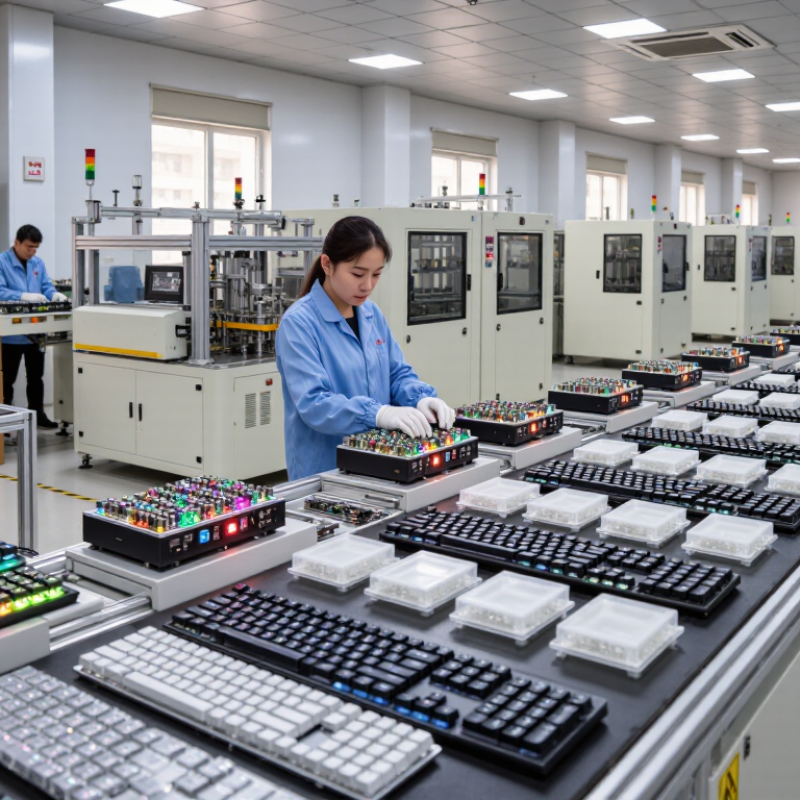
China Top RGB Mechanical Gaming Keyboard Manufacturers?

What Defines a Top RGB Mechanical Gaming Keyboard Manufacturer in China?

China’s top RGB mechanical gaming keyboard manufacturers are defined by engineering discipline, not bright lighting alone. In practical factory evaluations, quality begins with consistent switch placement and stable key feel. Engineers should measure actuation force, debounce performance, and sound across repeated samples. RGB diffusion also matters. Uneven lighting quickly reveals weak design.

Professional teams test keyboards through extended typing, gaming cycles, cable bending, and temperature changes. They inspect solder joints, stabilizers, keycaps, and USB connections. A reliable manufacturer keeps production records and traces defects to specific batches. It should also provide clear firmware documentation and responsive technical support. Short answers are not enough.

Firmware is often overlooked. It controls lighting effects, macros, compatibility, and update safety. A top supplier tests these functions on several operating systems before shipment. Independent certification can support credibility, but paperwork alone proves little. Factory visits, sample comparisons, and third-party inspections offer stronger evidence.

No manufacturer gets every batch perfect. Even experienced teams may miss a loose stabilizer or inconsistent coating. That weakness deserves honest discussion, not polished marketing. Buyers should ask about inspection standards, replacement procedures, tooling ownership, and realistic production capacity. A trustworthy partner explains limitations clearly and improves after receiving test feedback. Reliability grows through evidence, communication, and repeatable results.

Key Technologies Used in RGB Mechanical Gaming Keyboards

In evaluating Chinese RGB mechanical keyboard manufacturers, I look beyond lighting effects. The important question is how the lighting system is engineered. Many current designs place an individual SMD LED beside each switch. This supports per-key control, smoother animations, and clearer legends. A translucent switch housing can spread light, while an opaque housing creates sharper contrast. Both choices affect typing visibility. They are not interchangeable.

The keyboard’s microcontroller coordinates RGB data, key scanning, and USB communication. Efficient firmware keeps animations responsive without causing input delay. Pulse-width modulation controls brightness, but poor tuning may create visible flicker through a camera. Quality manufacturers test this at different brightness levels.

They also verify n-key rollover, debounce performance, and stable polling under heavy use. Hot-swappable sockets add convenience, yet repeated switch changes can loosen contacts. That detail is easy to miss.

Production quality depends on more than a capable PCB. Factory teams should inspect solder joints, LED color consistency, keycap legends, and cable strain relief. Burn-in testing can reveal heat problems or random lighting failures before shipment. In my experience, software remains the weakest link. A polished case cannot compensate for confusing controls or unreliable saved profiles. I also question extreme brightness claims; brighter is not always better. Comfortable diffusion, accurate colors, and dependable firmware matter more during long sessions.

Leading Chinese Manufacturers and Their Product Strengths

China’s leading RGB mechanical keyboard manufacturers combine flexible production with strong engineering depth. Many support OEM and ODM projects, allowing buyers to adjust layouts, keycap materials, switch types, and lighting effects. Their factories often use automated assembly lines, CNC-machined cases, and firmware testing stations. These details matter when a keyboard must survive long gaming sessions.

Product strength usually appears in practical features. Hot-swappable sockets simplify switch replacement. South-facing LEDs improve keycap compatibility. Gasket structures can create a softer typing feel, while aluminum frames add weight and stability. Reliable manufacturers also test USB ports, wireless connections, battery performance, and RGB consistency. During supplier evaluations, I prefer verified samples over impressive catalogs. One prototype may feel excellent, yet a later production batch can show uneven stabilizers or rattling keys. That risk deserves attention.

Tips: Request two samples from different production batches. Check latency, key wobble, software stability, and lighting brightness in a dim room. Ask for documented quality procedures and clear warranty terms. Certifications can support reliability, but they do not replace hands-on testing. Some manufacturers communicate quickly but provide vague technical answers. That is a warning sign. A strong supplier explains tolerances, testing methods, packaging protection, and realistic delivery limits. Perfect products are uncommon. Careful verification remains essential.

China Top RGB Mechanical Gaming Keyboard Manufacturers? - Leading Chinese Manufacturers and Their Product Strengths

Manufacturer Capability Profile Primary Product Focus Switch and Typing Options RGB and Firmware Strengths Connectivity Customization Capability Typical Production Scale Relevant Quality Controls
Full-Service OEM/ODM Factory Full-size, tenkeyless, 75%, 65%, and compact mechanical gaming keyboards Hot-swappable PCB options; 3-pin and 5-pin switch compatibility; linear, tactile, and clicky switches Per-key RGB, side lighting, multiple lighting effects, Windows configuration software, onboard profile storage USB-C wired; optional 2.4 GHz wireless and Bluetooth multi-device support Custom keycaps, cases, plates, logos, packaging, firmware layouts, and key legends Suitable for medium-to-large recurring orders Incoming material inspection, assembly testing, key stability checks, USB testing, and final appearance inspection
Gaming Performance Specialist Low-latency keyboards for competitive PC gaming and esports applications Mechanical switches with short actuation options; selected models support adjustable actuation or rapid-trigger functions High-brightness per-key RGB, game-specific profiles, macro assignment, lighting synchronization, and firmware updates Wired USB-C designs commonly support 1,000 Hz polling; selected performance models offer higher polling rates Custom performance firmware, debounce settings, actuation parameters, and dedicated macro layers Best suited to performance-focused product launches Polling-rate verification, latency testing, key registration testing, firmware validation, and endurance testing
Wireless Keyboard Manufacturer Compact 60%, 65%, 75%, and low-profile wireless mechanical keyboards Hot-swap and soldered switch versions; standard-height and low-profile mechanical switch platforms Per-key RGB with battery-saving modes, automatic sleep settings, onboard lighting memory, and wireless profile management Tri-mode configurations: USB-C wired, 2.4 GHz wireless, and Bluetooth Battery capacity, wireless receiver housing, antenna placement, layout, case material, and charging indicators Strong fit for portable and multi-device products Wireless range checks, charging-cycle tests, battery protection checks, connection recovery tests, and sleep-current testing
Value-Oriented High-Volume Factory Entry-level and mid-range RGB mechanical keyboards for retail and e-commerce channels Common linear and tactile switch options; membrane-mechanical hybrid designs may also be available Preset RGB zones or per-key lighting, hardware lighting shortcuts, and simplified configuration software Primarily USB wired; selected models add basic 2.4 GHz wireless functionality Standardized molds, printed keycap sets, color variations, cable options, and retail packaging Competitive for large-volume standardized production Automated key-function testing, visual inspection, cable testing, carton drop testing, and sampling inspection
Premium Materials and Design Factory Aluminum-case, gasket-mounted, enthusiast-oriented mechanical keyboards Hot-swappable PCBs, screw-in stabilizer support, lubricated stabilizer options, and multiple plate materials Per-key RGB, south-facing LEDs on selected layouts, VIA or QMK-compatible configurations, and layered lighting control USB-C wired; selected models include 2.4 GHz and Bluetooth connectivity CNC aluminum cases, brass or polycarbonate plates, acoustic foams, rotary encoders, artisan keycaps, and custom finishes Best for premium and enthusiast product lines CNC dimensional checks, anodizing inspection, stabilizer noise checks, acoustic evaluation, and assembly torque control
Layout and Regional Customization Specialist International layouts, language-specific keycap sets, and customized gaming keyboard bundles Standard mechanical switch families with support for ANSI, ISO, and selected regional layouts Per-key or zone-based RGB, multilingual software interfaces, remapping functions, and custom shortcut layers USB-C wired with optional 2.4 GHz or Bluetooth modules depending on the model Keycap legends, regional layouts, language packaging, user manuals, cable styles, and accessory bundles Useful for multi-market distribution programs Layout verification, legend inspection, software-language checks, packaging audits, and regional compliance review
Integrated Keycap and Peripheral Producer RGB mechanical keyboard sets bundled with mice, wrist rests, keycaps, or desk accessories OEM switch selection, standard hot-swap options, gaming-oriented actuation forces, and replacement switch support Keyboard-and-peripheral lighting coordination, synchronized effects, preset profiles, and desktop software integration USB wired platforms; wireless bundles may use shared or separate receivers Matched product colors, coordinated lighting, bundle packaging, accessory selection, and complete gaming-set design Efficient for coordinated product families Cross-product compatibility checks, USB power testing, lighting synchronization tests, packaging validation, and batch sampling
Capability ranges reflect common production options in China’s OEM/ODM mechanical keyboard sector. Actual specifications, minimum order quantities, lead times, certifications, and firmware functions should be confirmed with each shortlisted manufacturer before purchase.

How Chinese Keyboard Manufacturers Manage Quality and Customization

China’s top RGB mechanical keyboard manufacturers manage quality through repeatable processes, not attractive samples alone. In practical sourcing work, buyers should inspect switch consistency, stabilizer noise, keycap legends, and USB connection strength. Factory teams often test RGB brightness, firmware functions, and repeated key presses before shipment. Each production batch should have inspection records, component traceability, and clear acceptance standards.

Customization begins with a realistic technical brief. Manufacturers can adjust layouts, switch types, keycap materials, lighting effects, cable designs, and packaging. However, every change can affect cost, timing, or durability. A custom plate may improve stiffness but increase typing noise. A special keycap color may look accurate on screen yet differ under factory lighting. Sample approval is essential. It exposes problems early, although one sample cannot represent an entire batch. No process is flawless.

Tips: Request two or three samples from different production runs. Test them for key wobble, RGB uniformity, typing fatigue, and software stability. Ask how rejected units are handled. Confirm firmware ownership, replacement procedures, and final inspection standards in writing. Independent pre-shipment checks can add cost, but they often reveal loose sockets, uneven legends, or missing accessories before delivery. Feedback should remain specific, measurable, and documented.

How to Select the Right Chinese RGB Keyboard Manufacturer

Selecting the right Chinese RGB keyboard manufacturer requires more than comparing prices. A reliable supplier should explain its production process clearly, from switch installation to final lighting inspection. Ask for factory photos, audit documents, and recent production samples. A sample should be tested for key wobble, stabilizer noise, coating quality, and USB connection stability.

RGB performance also deserves careful testing. Request the lighting software before placing a large order. Check whether brightness remains even across the keyboard and whether custom effects save correctly. Confirm compatibility with the operating systems used by your customers. Ask about switch options, keycap materials, layout changes, and firmware updates. Small details matter here.

Communication reveals practical reliability. Can the manufacturer answer technical questions without vague promises? Confirm minimum order quantities, tooling fees, packaging standards, lead times, inspection procedures, and warranty handling in writing. Independent pre-shipment inspection can expose problems that factory videos miss. A cheaper quote may hide weaker plastic, inconsistent switches, or limited after-sales support. I have seen sourcing plans focus too heavily on RGB effects while ignoring cable strain relief and carton strength. That mistake is easy to repeat. Review relevant product safety requirements for your target market, and request accurate test records rather than decorative certificates. Keep a written sample approval, because memory changes quickly when production becomes busy.

The chart presents a practical weighted evaluation model for selecting a Chinese RGB mechanical keyboard manufacturer. Product quality and RGB reliability receive the highest weighting, followed by customization capability, compliance, production capacity, cost competitiveness, and communication efficiency.

FAQS

What customization options do Chinese mechanical keyboard manufacturers usually provide?

They may adjust layouts, switch types, keycap materials, lighting effects, cables, and packaging. Each change can affect cost, timing, or durability. Keep the brief specific.

How do manufacturers test keyboard quality before shipment?

Factory teams may inspect switch consistency, stabilizer noise, keycap legends, USB strength, firmware, and repeated key presses. They should keep inspection records for each batch. Paperwork helps, but hands-on checks matter more.

Why should buyers request samples from different production batches?

One excellent sample may not represent later production. Compare two or three units for wobbling keys, rattling stabilizers, and uneven lighting. Samples can mislead.

What features can improve typing comfort and keyboard stability?

Gasket structures can create a softer typing feel. Aluminum frames add weight and reduce movement. However, a stiffer plate may also increase typing noise.

What should buyers check during a practical keyboard inspection?

Test latency, wireless connections, battery performance, software stability, and RGB brightness in a dim room. Press every key. Notice fatigue after longer typing sessions.

How can buyers evaluate RGB lighting consistency?

View the keyboard in a dim room and compare brightness across several keys. Check different colors and lighting effects. Uneven illumination may appear only after assembly.

What information should a reliable supplier explain clearly?

Ask about tolerances, testing methods, packaging protection, delivery limits, warranty terms, and replacement procedures. Vague technical replies deserve caution. Fast communication is not enough.

Does certification guarantee reliable keyboard quality?

Certification can support confidence, but it cannot replace physical testing. Independent inspections may find loose sockets, poor legends, or missing accessories. No process is flawless.

How can buyers control risks in a custom keyboard project?

Approve a detailed sample and record measurable acceptance standards. Confirm firmware ownership, rejected-unit handling, and final inspection steps in writing. My judgment may still miss hidden batch problems.

Conclusion

China has become an important source of RGB Mechanical Gaming Keyboard manufacturing, supported by strong engineering capabilities, efficient supply chains, and flexible production systems. A top manufacturer typically combines reliable mechanical switches, precise key registration, customizable RGB lighting, durable materials, stable firmware, and ergonomic design. Advanced technologies such as hot-swappable sockets, anti-ghosting, N-key rollover, programmable keys, and software-based lighting control help improve both gaming performance and user experience.

Leading Chinese manufacturers often distinguish themselves through product variety, rapid development, competitive production capacity, and the ability to support private-label or customized projects. Quality management usually includes material inspection, assembly testing, performance verification, and final product evaluation. When selecting a suitable supplier, buyers should consider manufacturing experience, technical support, customization options, quality consistency, communication efficiency, production capacity, and delivery reliability. A clear evaluation process and well-defined specifications can help ensure that the final keyboard matches the intended market, performance expectations, and long-term business goals.


Evelyn

Evelyn

Evelyn is a highly experienced marketing professional dedicated to helping businesses understand the value, quality, and practical applications of our products. With a strong background in market research, content strategy, customer communication, and digital marketing, Evelyn combines industry......